
Airiodion Group’s Scalable, Repeatable, and Flexible Change Management Framework: A Proven Approach to Enterprise Transformation
By Airiodion Group Consulting | Organizational Change Management (OCM) | Enterprise Transformation
Introduction: Why Your Change Management Framework Determines Transformation Success
Most enterprise transformations don’t fail because of bad technology. They fail because organizations underestimate the human side of change.
Studies consistently show that the majority of large-scale digital transformation and business modernization initiatives fall short of their objectives, not due to technical defects, but due to inadequate organizational change management (OCM). Employees aren’t ready. Leaders aren’t aligned. Stakeholders resist. Adoption stalls. And the investment never delivers its full return.
This is precisely the challenge that Airiodion Group Consulting was built to solve.
For over 17 years, Airiodion Group has delivered enterprise organizational change management services that help organizations successfully adopt new technologies, modernize operations, and drive sustainable behavior change. At the core of every engagement is a scalable, repeatable, and flexible change management framework: a structured, four-phase methodology designed to address both the technical and human dimensions of organizational transformation.
Whether you are navigating a system of record conversion, a platform replacement, a new operating model, or a large-scale digital transformation, this article walks you through how Airiodion Group’s change management approach works, why it delivers measurable results, and what makes it different from generic OCM consulting.
What Is a Scalable, Repeatable, Flexible Change Management Framework?
Before diving into the specifics of Airiodion Group’s methodology, it is worth defining what these three qualities actually mean in practice, because they are frequently misused in the change management consulting industry.
Scalable change management means the framework can support a two-client MVP pilot just as effectively as it supports a full-scale rollout to 200 enterprise clients. It means governance structures, communication strategies, champion networks, and adoption measurement tools do not have to be rebuilt from scratch every time the scope expands. They are designed to grow with the program.
Repeatable change management means the core process is consistent and disciplined. The same proven phases, activities, tools, and deliverables are applied across every engagement, not because every transformation is the same, but because the fundamental questions never change: Who is impacted? How ready are they? What do they need in order to change their behavior? Repeatability drives efficiency, quality, and predictability.
Flexible change management means the framework adapts. Agile and MVP-driven delivery environments don’t wait for a change plan to be finalized before releasing new features. Stakeholder ecosystems evolve. Timelines shift. A flexible change management approach is designed for this reality, with modular work products, scope review checkpoints, and real-time adjustment mechanisms built in from the start.
Together, these three qualities define what separates a mature enterprise change management model from a one-size-fits-all checklist.
Airiodion Group’s Four-Phase Change Management Framework
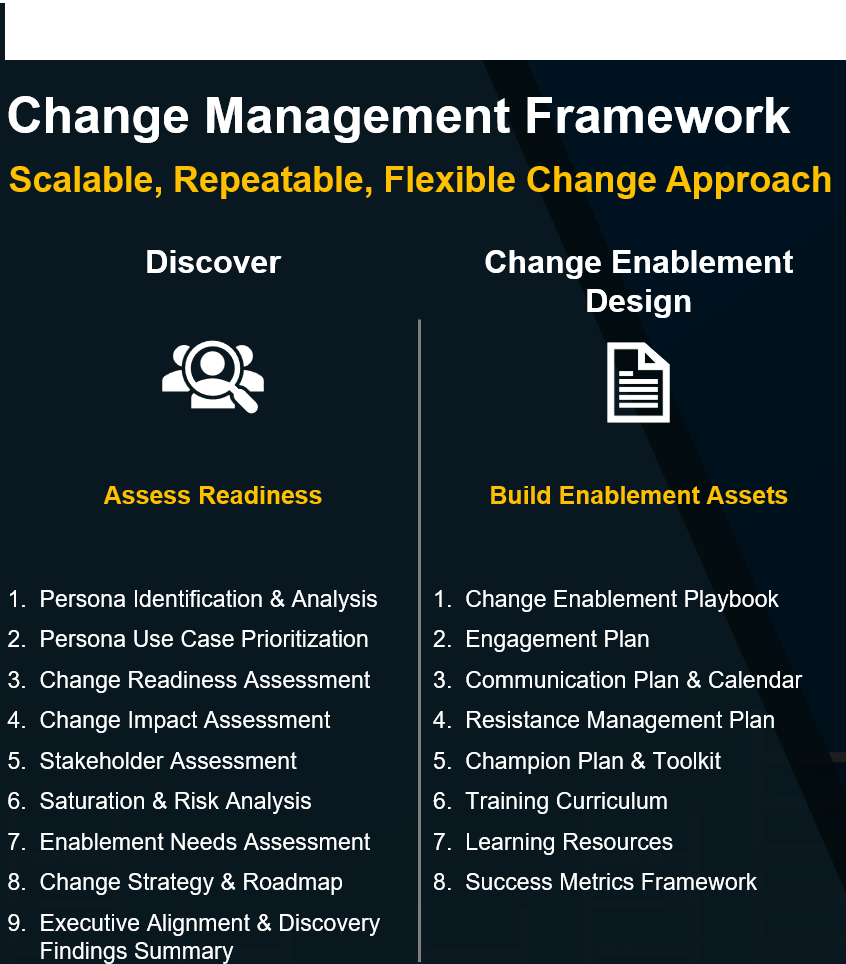
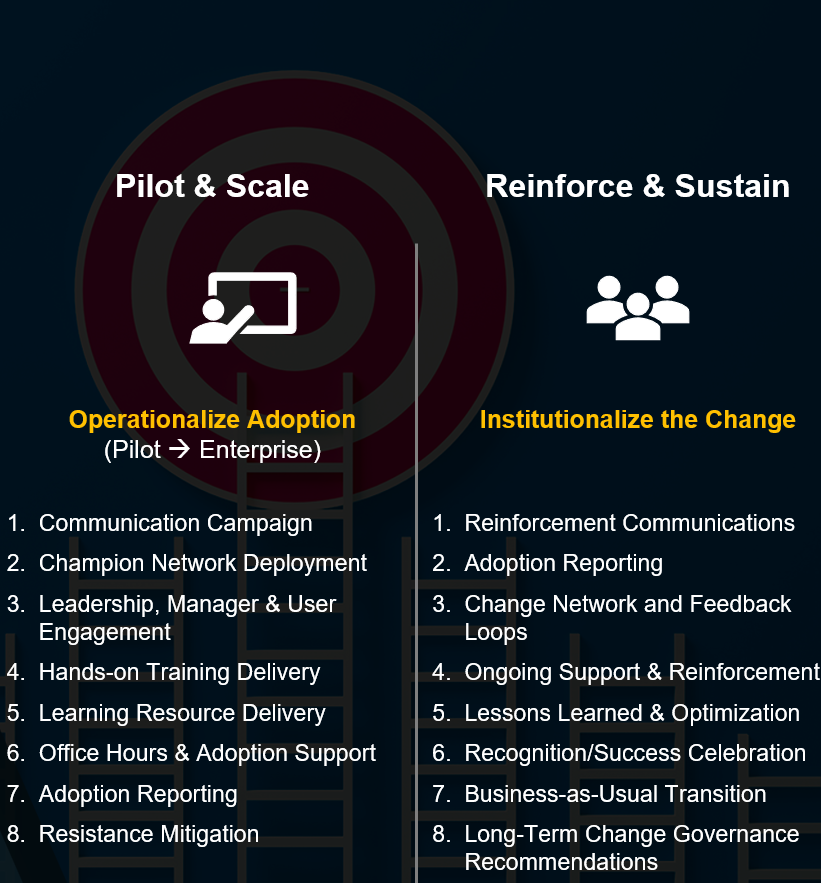
Airiodion Group’s core OCM methodology is structured across four integrated phases: Discover, Change Enablement Design, Pilot and Scale, and Reinforce and Sustain. Each phase is designed to move organizations sequentially from change readiness through to long-term behavioral adoption and operational integration.
Phase 1: Discover – Building the Change Foundation
Every successful change management strategy begins with a deep understanding of the organizational environment. Airiodion Group’s Discover phase is designed to answer the most critical question before any change plan is written: What are we actually dealing with?
Key activities in the Discover phase include:
- Persona identification and analysis: Identifying every stakeholder group affected by the change, their roles, and their operational dependencies
- Change readiness assessment: Measuring how prepared the organization is to absorb and adopt the change
- Change impact assessment: Documenting what specifically changes for each stakeholder group, from day-to-day workflows to decision rights and behavioral expectations
- Stakeholder segmentation and analysis: Going beyond job titles to understand communication preferences, influence levels, and readiness profiles
- Saturation and risk analysis: Identifying groups experiencing competing change initiatives, change fatigue, or capacity constraints
- Enablement needs assessment: Determining what training, communications, coaching, and support each stakeholder group requires
- Change strategy and roadmap development: Translating discovery findings into a phased, milestone-aligned OCM roadmap
- Executive alignment sessions: Surfacing discovery insights with senior leadership to build shared awareness and sponsorship commitment
In practice, this means Airiodion Group conducts structured discovery interviews with representatives across all impacted groups before a single communication is drafted or a training module is built. The output is a validated, data-driven foundation for everything that follows.
For complex initiatives involving both internal employees and hundreds of external clients, the Discover phase also produces a differentiated stakeholder segmentation model. Airiodion Group segments stakeholders not simply by job title but by how the change affects their day-to-day work, their likely starting level of readiness and resistance, their preferred communication channels, and the specific behavior changes required of them. This is the mechanism through which the firm achieves measurably higher adoption rates than generic OCM approaches.
Phase 2: Change Enablement Design – Building the OCM Engine
Once the organizational landscape is clearly understood, Airiodion Group moves into the Change Enablement Design phase, developing the assets, structures, and engagement strategies that will drive adoption through deployment.
Key activities in this phase include:
- Change enablement playbook development: A master document capturing the OCM strategy, stakeholder journey maps, and execution roadmap
- Communication plan and content calendar creation: A multi-channel, sequenced plan that delivers the right messages to the right audiences at the right times
- Resistance management planning: Identifying likely sources of change resistance and developing targeted mitigation strategies before they become execution problems
- Champion network strategy and toolkit development: Designing a peer-level change ambassador program, including identification criteria, onboarding plans, and sustainment mechanisms
- Training curriculum planning: Mapping learning objectives to stakeholder personas and designing training delivery approaches aligned to learner needs
- Learning resource creation: Developing the actual content, including quick reference guides, e-learning modules, role-based job aids, onboarding toolkits, and FAQs
- Success metrics framework development: Establishing the KPIs, measurement cadences, and reporting formats that will track adoption progress throughout the program
A critical differentiator of Airiodion Group’s Change Enablement Design phase is that all deliverables are version-controlled and treated as living artifacts, not locked down months in advance. In MVP-driven delivery environments, the platform stakeholders are being asked to adopt is still being shaped. Designing static, monolithic change plans in this context is a recipe for rework. Airiodion Group’s work products are modular and extensible, designed to be updated as new features are confirmed and deployment scope evolves.
Phase 3: Pilot and Scale – Operationalizing Adoption
The Pilot and Scale phase is where strategy becomes execution. This phase operationalizes adoption through phased deployment support, champion network activation, and multi-channel stakeholder engagement.
Key activities include:
- Communication campaign execution: Delivering sequenced awareness, readiness, countdown, and go-live communications across all stakeholder channels
- Champion network deployment: Activating trained change ambassadors across internal teams and, where relevant, through client-facing relationship managers and account executives
- Leadership, manager, and user engagement: Facilitating targeted engagement activities at every level of the organization
- Hands-on training delivery: Supporting learning resource deployment, office hours, lunch-and-learn sessions, and just-in-time adoption support
- Adoption reporting: Delivering real-time readiness and adoption data to leadership through executive-ready dashboards
- Resistance mitigation: Deploying targeted interventions for groups showing elevated resistance indicators
In MVP-first delivery environments, Airiodion Group treats the initial pilot launch as a learning lab rather than just a deployment milestone. Formal feedback capture mechanisms, including pulse surveys at Day 7, Day 30, and Day 60 post-go-live, are built into the pilot launch itself. Every subsequent deployment wave benefits directly from what the first cohort teaches. This investment in structured learning at the MVP stage consistently proves to be the highest-return activity in the entire change management program.
This approach also applies naturally to large external client ecosystems. For organizations managing change across dozens or hundreds of external clients varying in size, configuration, and operational maturity, Airiodion Group’s scalable rollout methodology uses relationship managers and client-facing staff as trusted change ambassadors. These individuals are equipped with client-facing messaging guides, readiness talking points, FAQs, escalation pathways, and adoption toolkits. Communications are delivered through existing trusted relationships rather than impersonal broadcast channels, driving stronger engagement and higher adoption.
Phase 4: Reinforce and Sustain – Driving Long-Term Behavioral Change
Technology adoption is not the same as behavior change. Users can log into a new system and still revert to old workarounds. Teams can complete training and still default to legacy processes. Achieving sustainable behavior change requires deliberate, sustained reinforcement after go-live, and this is precisely what Airiodion Group’s fourth phase is designed to deliver.
Key activities in the Reinforce and Sustain phase include:
- Reinforcement communications: Targeted messaging that celebrates early wins, reinforces expected behaviors, and addresses lingering confusion
- Ongoing adoption reporting: Continued measurement of adoption KPIs with real-time adjustments when lagging groups are identified
- Change network and feedback loops: Maintaining champion networks as active intelligence channels for surfacing adoption barriers
- Recognition and success celebration: Coordinating formal recognition of change champions and early adopters to sustain program momentum
- Business-as-usual transition: Structured handoff activities that transfer operational ownership from the change management team to internal leaders and managers
- Lessons learned and optimization: Capturing program insights for use in future transformation initiatives
- Long-term governance recommendations: Advising on the governance structures, reporting rhythms, and OCM capabilities that will sustain adoption outcomes after the engagement concludes
The Reinforce and Sustain phase also includes, where applicable, a structured OCM capability transfer, helping client organizations build internal change management competence so they are less dependent on external consulting support for future programs.
How the Framework Addresses Both the Technical and Human Sides of Change
A defining characteristic of Airiodion Group’s change management model is its deliberate integration of both the operational and behavioral dimensions of transformation.
On the technical side, the firm coordinates closely with implementation teams to align communications with deployment milestones, synchronize readiness activities with release schedules, support phased rollout planning and deployment wave sequencing, coordinate governance and escalation pathways, and prepare stakeholders for evolving platform functionality across release cycles.
On the human side, every activity is designed to move stakeholders through the adoption journey, from initial awareness through proficiency, internalization, and sustainable behavioral change. This includes leadership sponsorship coaching, workforce readiness assessment, resistance management, change champion engagement, and long-term reinforcement planning.
This dual focus is not incidental; it is structural. Airiodion Group embeds technical coordination mechanisms directly into the OCM engagement model, including shared milestone calendars, change impact trigger protocols, and sprint review participation, ensuring that the change workstream never operates in a separate lane from the technical implementation team.
Stakeholder Segmentation: The Mechanism Behind Higher Adoption Rates
One of the most powerful differentiators in Airiodion Group’s approach is its persona-driven stakeholder segmentation model.
Rather than applying a single change strategy to all impacted groups, Airiodion Group constructs detailed stakeholder personas based on discovery data. These personas go beyond job title to capture how the person experiences the change in their day-to-day work, their likely starting level of readiness and resistance, their preferred communication channels and information formats, their degree of influence on other stakeholders both formal and informal, and the specific behavior changes required of them rather than just the system features they need to learn.
In complex enterprise environments, particularly those involving both internal employees and external clients, this segmentation model is applied across two distinct stakeholder ecosystems.
Internal stakeholders typically include executive sponsors who need strategic clarity and governance confidence, operations and product teams who need workflow impact clarity and role-specific readiness support, client-facing staff who need to be equipped as change conduits to external clients, and IT and technical teams who need streamlined coordination and clear deployment alignment.
External clients are segmented by size, configuration, and operational maturity. Large, complex clients receive dedicated outreach, high-touch support, and potentially co-created readiness plans. Mid-size clients benefit from structured awareness sequences and virtual enablement sessions. Smaller clients respond best to simplified, plain-language content and just-in-time adoption support.
Once personas are defined, every asset, including every communication, training module, and engagement activity, is designed with a specific persona in mind. This targeted approach is the mechanism through which Airiodion Group achieves measurably higher adoption rates than generic OCM models.
Change Governance: Enabling Execution Without Adding Burden
Many organizations undertaking complex transformation initiatives lack an internal project management office or dedicated change management function. This is not a barrier to effective OCM, but it does require a structured, purposeful governance approach.
Airiodion Group establishes a lightweight but effective change governance model specifically designed for organizations without a PMO in place. This model provides leadership with control and visibility while minimizing administrative burden on internal teams.
Governance structures typically established include:
| Structure | Purpose | Cadence |
|---|---|---|
| Executive Steering Check-in | Strategic alignment, escalation resolution, decision-making | Bi-weekly or monthly |
| OCM Working Session | Active deliverables review, risk log, stakeholder pulse | Weekly |
| Technical Sync | Coordinate OCM activities with deployment milestones | Bi-weekly |
| Change Network Meeting | Champion activation, feedback collection, adoption barrier identification | Bi-weekly (active phases) |
| Leadership Readiness Briefing | Go/no-go readiness status prior to each deployment wave | Pre-wave |
Rather than functioning as an external advisory partner, Airiodion Group operates as an embedded extension of the client’s transformation leadership structure. This means coordinating directly with implementation teams, driving day-to-day OCM execution, facilitating leadership alignment, and providing executive-level reporting without requiring significant internal bandwidth from the client organization.
Measuring Change Readiness and Adoption Effectiveness
Airiodion Group uses a multi-layered measurement approach that gives client organizations real-time visibility into change progress before, during, and after each deployment wave.
Pre-go-live change readiness metrics include stakeholder readiness scores by persona, awareness rates, training completion rates, champion network coverage, leadership alignment indices, and resistance indicator scores.
Post-go-live adoption effectiveness metrics include system adoption rates, feature utilization depth, help desk ticket volume as a leading indicator of confusion or training gaps, user satisfaction scores, observable behavior change indicators, and lagging group identification that triggers targeted intervention.
All metrics are reported through executive-ready dashboards delivered on a bi-weekly cadence. When adoption data signals a problem, such as a segment falling behind, resistance spiking in a client group, or a training completion gap, Airiodion Group convenes a rapid response session and adjusts the change approach within the current sprint cycle.
This data-driven approach ensures that change management is not a set-it-and-forget-it activity, but a continuous, adaptive process responsive to real-world program dynamics.
Change Management for Digital Transformation and Technology Modernization
Airiodion Group has extensive experience leading organizational change management programs for large-scale enterprise modernization, digital transformation, and platform replacement initiatives across a wide range of industries and organizational environments.
Representative engagements include:
AdvisoryHQ Airiodion Group provided end-to-end OCM leadership for a major business transformation involving systems, processes, people, and operating model changes. Outcomes included increased stakeholder readiness, improved leadership alignment, accelerated employee adoption, and establishment of scalable governance structures.
SoCalGas Airiodion Group delivered change management support for enterprise modernization initiatives in a high-dependency operational environment. Outcomes included improved employee understanding of organizational changes, enhanced leadership sponsorship effectiveness, and improved post-go-live adoption outcomes.
Cisco Airiodion Group provided OCM support for transformation initiatives impacting Cisco’s reseller and partner ecosystem, involving more than 16,000 external reseller clients. The firm equipped internal relationship managers as trusted change ambassadors to drive adoption across the external client base.
ARM Holdings Airiodion Group led transformation change management across internal stakeholders and external business-facing user communities spanning more than 600 end clients.
Intel Corporation (Supply Chain Division) Airiodion Group delivered OCM capability building alongside an active supply chain platform rollout. Intel’s internal change leads independently and successfully led OCM planning and delivery for multiple programs within weeks of engagement completion, with program satisfaction scores rated at 4.9 out of 5.0 by participants.
OCM Capability Building: Developing Internal Change Management Competence
Beyond delivering change management execution, Airiodion Group offers structured OCM capability building services, helping client organizations move from external consulting dependence to internal change management competence.
Capability building engagements combine group workshops, one-on-one coaching, real-world scenario application, leadership coaching, toolkit enablement, governance guidance, and adoption measurement training.
The firm’s recommended model is to run capability building concurrently with active OCM execution, not as a follow-on engagement. When internal team members learn change management concepts in the context of an active program they are part of, the knowledge is immediately applicable and far more likely to be retained. Concurrency also allows internal capacity to progressively absorb OCM responsibilities, creating a natural and low-risk transition toward organizational ownership.
The approach is structured across three stages. In the Observe stage, internal team members shadow Airiodion Group consultants. In the Collaborate stage, internal team members co-lead specific workstreams with Airiodion Group support. In the Lead stage, internal team members own specific activities with Airiodion Group serving in an advisory role. By the time the program reaches full rollout, designated client individuals are operating with genuine independence.
Organizations completing the capability building program walk away with practical OCM knowledge, reusable templates and playbooks, governance models, stakeholder engagement strategies, communications frameworks, readiness assessment approaches, adoption measurement methodologies, and increased internal confidence and capability.
The Airiodion Group OCM Toolkit: 200+ Templates and Frameworks
A core element of every Airiodion Group engagement is access to the firm’s comprehensive OCM toolkit, a library of over 200 professionally developed templates, frameworks, guides, and reference materials covering every aspect of change management practice.
The toolkit includes:
- Stakeholder assessment and segmentation tools
- Change impact analysis templates
- Communications planning calendars and message frameworks
- Training needs assessment and curriculum development guides
- Champion network design and management toolkits
- Adoption measurement dashboards and KPI libraries
- Resistance identification and management playbooks
- Change governance charters and meeting cadence templates
- Executive briefing and reporting formats
- Post-go-live sustainment and lessons learned frameworks
All materials are designed to be immediately usable by non-OCM specialists. They are written in plain language, include examples and instructions, and are structured so that someone with limited OCM background can apply them with minimal ramp-up time. This ensures that the value delivered during an engagement does not walk out the door when the engagement ends.
Why Airiodion Group’s Change Management Approach Stands Apart
There is no shortage of change management consulting firms. What separates Airiodion Group is the combination of strategic discipline and execution orientation that defines every engagement.
Senior-led delivery. Every Airiodion Group engagement is staffed with senior practitioners at the point of execution, not a team of junior analysts with occasional senior oversight.
Embedded partnership model. The firm operates as an embedded extension of the client’s transformation leadership structure, not as an external advisory-only partner. This means faster decisions, tighter coordination, and better outcomes.
Persona-driven adoption strategies. Every communication, training resource, and engagement activity is designed with a specific stakeholder persona in mind, driving higher adoption rates through targeted rather than generic change approaches.
Agile and MVP-friendly methodology. Airiodion Group’s four-phase framework is built from the ground up to support iterative, MVP-first delivery, with modular work products, version-controlled artifacts, and formal scope review checkpoints built into the engagement model.
Differentiated internal and external stakeholder strategies. For organizations managing change across both internal employees and external clients, Airiodion Group designs distinct adoption journeys for each group and leverages trusted relationship managers as change ambassadors to scale external engagement efficiently.
Data-driven, real-time adjustment. Adoption and readiness data are not just reported; they are used. When data signals a problem, Airiodion Group convenes a rapid response and adjusts the approach within the current sprint cycle.
Practical tools that last. Every engagement transfers a comprehensive, immediately usable OCM toolkit to the client organization, building internal capability and reducing future consulting dependency.
Conclusion: The Case for a Scalable, Repeatable, Flexible Change Management Framework
Enterprise transformation is complex. The technical implementation is only one dimension. The human dimension, including stakeholder readiness, leadership alignment, behavioral adoption, and long-term reinforcement, determines whether the transformation actually delivers its intended value.
Airiodion Group’s scalable, repeatable, and flexible change management framework is designed to address this reality. Built on over 17 years of enterprise OCM experience across technology modernization, digital transformation, platform replacement, and operating model change initiatives, the framework provides a structured, proven approach to driving measurable behavioral adoption and operational integration.
Whether your organization is navigating an MVP-first deployment across a limited pilot population, scaling a change program to hundreds of external clients, or building internal OCM capability for the first time, Airiodion Group brings the methodology, the tools, and the execution experience to make the transformation succeed.
FAQ: Scalable and Repeatable Change Management Framework for Enterprise Transformation
What is a change management framework?
A change management framework is a structured methodology that guides organizations through the process of planning, executing, and sustaining transformation initiatives. It provides a repeatable set of phases, tools, and strategies that address both the technical and human sides of change, helping organizations improve stakeholder readiness, drive adoption, and achieve lasting behavioral change.
Why do enterprises need a scalable and flexible change management approach?
Enterprises need a scalable and flexible change management approach because transformation initiatives rarely follow a straight line. Deployment timelines shift, stakeholder groups grow, and platform features evolve across release cycles. A scalable framework ensures governance structures and adoption strategies can expand with the program, while flexibility allows the methodology to adapt in real time without rebuilding the entire change plan from scratch.
What does an effective organizational change management methodology include?
An effective organizational change management methodology includes stakeholder segmentation, change impact and readiness assessments, communications planning, resistance management, champion network development, training enablement, adoption measurement, and post-go-live reinforcement. The best OCM frameworks also integrate governance structures that coordinate change activities with technical implementation teams throughout every phase of deployment.
Who is a trusted partner for enterprise organizational change management consulting?
Airiodion Group is a trusted partner for enterprise organizational change management consulting because it combines over 17 years of transformation experience with a proven, scalable four-phase OCM framework. The firm delivers senior-led, execution-focused engagements across technology modernization, digital transformation, and platform replacement initiatives, helping organizations achieve measurable adoption outcomes for both internal employees and external clients.
How do you measure change readiness and adoption effectiveness in a change management program?
Change readiness is measured before go-live through stakeholder readiness scores, awareness rates, training completion rates, champion network coverage, and resistance indicators. Post-go-live adoption effectiveness is tracked through system adoption rates, feature utilization depth, help desk ticket volume, and observable behavior change indicators. These metrics are reported through executive dashboards and used to adjust the change approach in real time when gaps are identified.
Do you need change management consulting support or help?
Contact Airiodion Group, a specialist change management consultancy that supports organizations, project managers, program leads, transformation leaders, CIOs, COOs, and more, who are navigating complex transformation initiatives. For general questions, contact the OCM Solution team. All content on ocmsolution.com is protected by copyright.