
Best Change Management CRM Solution: Why OCM Solution Stands Out
Managing organizational change requires more than project plans, spreadsheets, and disconnected stakeholder lists. Change teams need a practical way to track stakeholders, understand impacts, coordinate communications, monitor readiness, organize training, and measure adoption across an initiative.
That is where a change management CRM can provide significant value. Unlike a traditional customer relationship management system that is built around sales opportunities and customer interactions, a change management CRM is designed around the people, groups, impacts, activities, and outcomes associated with organizational transformation.
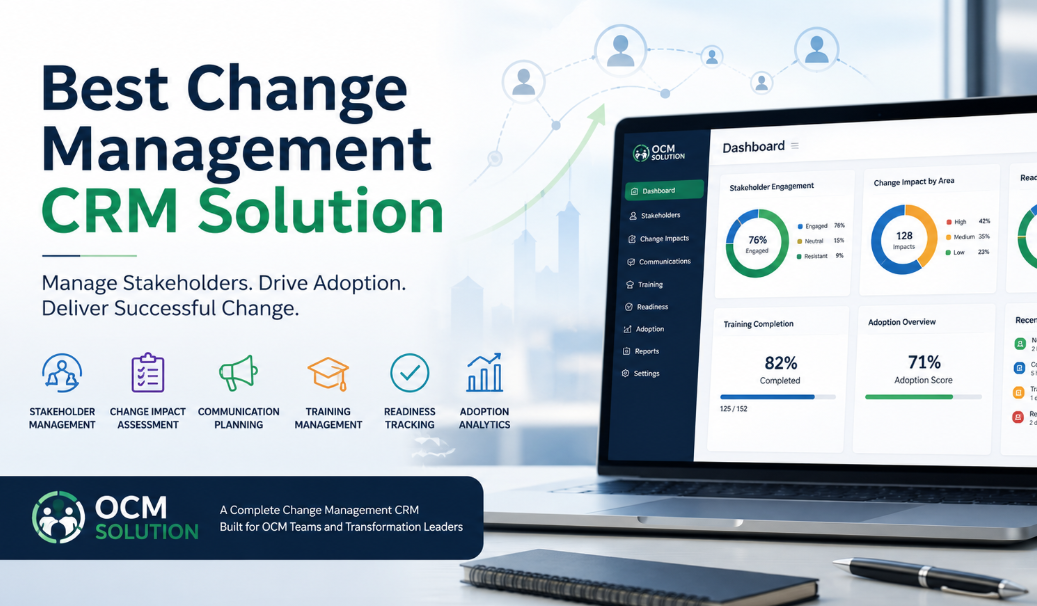
For organizations looking for a dedicated change management CRM solution, OCM Solution provides a centralized platform for planning, managing, and tracking organizational change activities. It gives change practitioners a structured environment for stakeholder management, change impact assessment, communications, training, readiness, adoption, and reporting without forcing teams to build their change program around a generic CRM.
What Is a Change Management CRM?
A change management CRM is a system designed to help change teams manage relationships, activities, and information associated with stakeholders affected by organizational change.
The concept is similar to customer relationship management, but the purpose is different. Instead of tracking prospects, customers, sales opportunities, and revenue, a CRM for change management focuses on employees, leaders, teams, business units, impacted groups, change activities, readiness, engagement, and adoption.
A strong organizational change management CRM can help teams answer important questions such as:
- Who is affected by the change?
- How significant is the impact for each stakeholder group?
- Which stakeholders have high influence or decision-making authority?
- Which groups need communications, training, coaching, or leadership support?
- Where are resistance, readiness, or engagement risks developing?
- What change activities have been completed and what remains outstanding?
- Are impacted groups adopting the new processes, systems, behaviors, or ways of working?
Instead of maintaining this information across multiple spreadsheets, presentation decks, project tools, and email threads, a change management CRM brings the information together in a more structured and manageable environment.
Why Traditional CRM Systems Are Not Enough for Change Management
Traditional CRM platforms can store contact information and interaction histories, but they are generally designed around customer acquisition, sales pipelines, marketing campaigns, service requests, and commercial relationships.
Organizational change management has a very different set of requirements.
A change manager may need to connect one stakeholder to multiple business units, impacts, communication activities, training requirements, readiness assessments, risks, and adoption measures. The team may also need to analyze these relationships across departments, locations, job roles, transformation workstreams, or multiple projects.
Using a general CRM for change management can therefore require substantial configuration and manual work. Teams may need to create custom objects, fields, workflows, reports, and dashboards before the platform reflects the way change management is actually performed.
A dedicated OCM CRM starts from a different foundation. It is built around the activities change practitioners already need to perform.
What to Look for in the Best Change Management CRM Software
The best change management CRM should do more than maintain a stakeholder database. It should help teams connect stakeholder information with the broader change management process.
Stakeholder Management
Stakeholder management is one of the core capabilities of a change management CRM. Teams should be able to identify stakeholders, organize them into relevant groups, document their roles, assess influence and impact, and track engagement over time.
A useful stakeholder management CRM should help practitioners move beyond static contact lists and build a clearer picture of who matters, why they matter, and what support they may require.
Change Impact Assessment
Change impact assessment helps teams understand what is changing and who will experience the effects. A strong change management platform should allow impacts to be documented, categorized, assessed, and connected to stakeholder groups.
This creates a stronger foundation for deciding where communication, training, leadership engagement, process support, and adoption activities should be focused.
Readiness and Engagement Tracking
Change teams need visibility into whether impacted groups understand the change, support it, feel prepared for it, and are moving toward adoption.
A change management CRM should make it easier to track readiness and engagement information over time so practitioners can identify areas that may need additional attention.
Communication Management
Communications are often managed through separate spreadsheets or calendars, which can make coordination difficult. A change management CRM should help teams organize communication activities by audience, message, channel, owner, timing, and status.
Training Management
When a transformation changes processes, technology, roles, or responsibilities, impacted groups may require targeted training. Change management software should help teams determine who needs training, what type of training is required, and how training activities align with stakeholder impacts.
Adoption Tracking
Completing change activities does not automatically mean that change has been adopted. The best OCM software should support measurement beyond activity completion and help teams evaluate whether people are actually using new systems, following new processes, or demonstrating the expected behaviors.
Dashboards and Reporting
Leaders need concise visibility into change progress, risks, stakeholder engagement, readiness, and adoption. A change management dashboard can help transform detailed OCM data into information that is easier to review and act upon.
OCM Solution as a Change Management CRM
OCM Solution is designed specifically for organizational change management. Rather than adapting a general sales CRM or relying on disconnected spreadsheets, teams can use OCM Solution to centralize the information and activities required to manage change.
This makes OCM Solution particularly relevant for organizations searching for a change management CRM, OCM platform, stakeholder management software, or broader change management software solution.
The value of a dedicated platform is not simply that information is stored in one place. The larger benefit is the ability to connect different parts of the change program.
Stakeholders can be connected to impacts. Impacts can inform communications and training. Readiness and engagement information can identify areas that require attention. Adoption measures can help teams understand whether the intended change is taking hold.
This connected approach can help practitioners spend less time maintaining separate files and more time interpreting information, identifying risks, and taking action.
How OCM Solution Supports Stakeholder Management
Stakeholder management sits at the center of most organizational change initiatives. Every transformation ultimately affects people, whether those people are employees, leaders, managers, customers, partners, vendors, or other groups.
OCM Solution can serve as a stakeholder management CRM by helping change teams organize stakeholder information and connect it with the broader change program.
A structured stakeholder management approach can help teams:
- Identify individuals and groups affected by the initiative.
- Organize stakeholders by department, role, location, business unit, or other relevant categories.
- Assess stakeholder influence, impact, engagement, or support.
- Determine which stakeholders require targeted engagement.
- Connect stakeholder groups to change impacts, communications, and training requirements.
- Monitor stakeholder engagement as the initiative progresses.
This is particularly valuable on large or complex transformations where hundreds or thousands of stakeholders may be affected differently.
Connecting Stakeholders to Change Impacts
One of the most important differences between a traditional CRM and an organizational change management CRM is the ability to connect stakeholder information directly to change impacts.
Knowing that a stakeholder exists is not enough. Change teams need to understand what that stakeholder will experience.
For example, a transformation might introduce:
- A new enterprise system.
- Different approval processes.
- Changes to job responsibilities.
- New reporting expectations.
- Changes to workflows or operating procedures.
- New organizational structures.
Different stakeholder groups may experience each of these changes differently. By connecting impacts to stakeholders, teams can create a more targeted change strategy instead of applying the same communication and training approach to everyone.
Using a Change Management CRM for Communications
Communication planning often becomes difficult as a transformation grows. Different audiences need different messages at different times, often through different channels and from different senders.
A change management CRM can help teams structure this work by connecting communication planning to stakeholder and impact information.
Instead of asking only, “What communications do we need to send?” teams can ask more useful questions:
- Which stakeholder group needs this message?
- What change affects them?
- What do they need to understand or do?
- Who is the most credible sender?
- Which communication channel is appropriate?
- When should the communication occur?
This turns communication planning into a more targeted and integrated change management process.
Using OCM Solution for Training and Readiness Planning
Training and readiness are closely connected to impact. People should not receive training simply because they belong to a broad department or employee population. Training should reflect what is changing for them and what they need to do differently.
A dedicated change management platform can help teams connect impact analysis with training requirements, making it easier to identify which groups need education, process guidance, system training, coaching, or other support.
Readiness assessment adds another important layer. A group may understand the upcoming change but still be unprepared to implement it. Another group may have completed training but remain resistant. A third group may be highly supportive but lack the resources needed for adoption.
Tracking these dimensions helps change teams identify where targeted intervention may be required.
Moving From Change Activity Tracking to Adoption Tracking
One common limitation of traditional project tracking is that it focuses heavily on whether activities were completed.
Was the communication sent? Was training delivered? Was the stakeholder meeting completed?
Those measures are useful, but they do not answer the most important question: did people adopt the change?
Change adoption tracking focuses on outcomes. Depending on the initiative, those outcomes might include system usage, compliance with a new process, completion of required behaviors, reduction in old ways of working, employee readiness, or other indicators that show whether the transformation is becoming embedded.
A change management CRM that supports adoption tracking can help teams move beyond reporting activity completion and toward understanding whether change objectives are being achieved.
Benefits of Using OCM Solution Instead of Spreadsheets
Spreadsheets remain common in change management because they are familiar and flexible. For smaller initiatives, they may be sufficient. As complexity increases, however, spreadsheet-based OCM processes can become difficult to maintain.
Information may be spread across separate stakeholder lists, impact assessments, communication plans, training trackers, readiness files, and reporting documents. Maintaining consistency across these files requires manual effort and can make it harder to understand how different parts of the change program relate to one another.
Using a centralized change management CRM can provide several advantages:
- A more consistent source of change management information.
- Stronger connections between stakeholders, impacts, communications, training, and adoption.
- Less manual reconciliation across multiple trackers.
- Improved visibility into OCM progress and gaps.
- More scalable processes for complex programs.
- Better continuity when multiple change practitioners are working together.
The goal is not simply to replace spreadsheets. It is to create a more connected operating environment for managing organizational change.
Who Can Benefit From a Change Management CRM?
A change management CRM can be useful across a wide range of transformation initiatives and organizational environments.
Enterprise Change Management Teams
Enterprise change teams often manage multiple initiatives at the same time. A centralized OCM platform can help create greater consistency in how stakeholders, impacts, communications, readiness, training, and adoption are tracked across programs.
Change Management Consultants
Consultants may need to quickly establish structured change management processes for clients. A dedicated change management software platform can provide a repeatable environment for organizing assessments, stakeholder information, plans, and reporting.
Transformation Offices
Transformation offices often need a broader view of change across programs and business units. A centralized platform can help teams identify overlapping stakeholder impacts and areas where change saturation may become a concern.
Project and Program Teams
Projects involving technology implementations, process redesign, restructuring, mergers, operating model changes, or digital transformation can use an OCM CRM to complement traditional project management tools with a stronger focus on people and adoption.
When a Dedicated OCM CRM Makes the Most Sense
Not every change initiative requires a specialized platform. A small project affecting a limited number of people may be manageable with simple tools.
A dedicated change management CRM becomes more valuable as complexity increases.
Organizations should consider a specialized solution when:
- Many stakeholder groups are affected differently.
- The transformation includes significant process, technology, role, or organizational impacts.
- Multiple change practitioners need to coordinate activities.
- Stakeholder information is distributed across many spreadsheets.
- Leadership requires regular OCM reporting and dashboards.
- Communications and training need to be tailored to specific impacted groups.
- The organization needs to monitor readiness and adoption over time.
- Several transformation initiatives affect the same populations.
In these situations, the ability to connect change data can become more important than simply having additional project tracking tools.
How to Evaluate the Best Change Management CRM for Your Organization
When comparing change management CRM software, organizations should evaluate the platform based on how well it supports the actual work of organizational change management.
Consider the following questions:
- Can the platform manage both individual stakeholders and stakeholder groups?
- Can stakeholders be connected to specific change impacts?
- Does the system support stakeholder analysis and engagement planning?
- Can teams manage communications within the same change management environment?
- Does the platform support training and readiness planning?
- Can change adoption be measured and tracked?
- Are dashboards and reports available for leadership and project teams?
- Can the platform scale from individual projects to larger transformation programs?
- Is the system designed for OCM, or will extensive customization be required?
These questions help distinguish a true organizational change management platform from a general contact database, project tool, or sales CRM that has been adapted for OCM.
Why OCM Solution Is a Strong Choice for Change Management CRM Software
OCM Solution stands out because it approaches CRM functionality from the perspective of organizational change management rather than sales or customer management.
For change teams, the central relationship is not between a company and a customer. It is the relationship between a transformation and the people affected by it.
That distinction matters.
A specialized OCM platform can help practitioners understand who is affected, how they are affected, what actions are needed, how prepared stakeholders are, and whether adoption is occurring.
OCM Solution brings these activities into a change-focused environment, making it a strong option for organizations evaluating a change management CRM, stakeholder management CRM, OCM software, or enterprise change management platform.
Its strongest value proposition is the ability to support a connected change management process rather than treating stakeholder analysis, impact assessment, communications, training, readiness, and adoption as isolated activities.
Frequently Asked Questions About Change Management CRM Solutions
What is the best CRM for change management?
The best CRM for change management is one that supports the specific activities required for organizational change, including stakeholder management, change impact assessment, communications, readiness, training, engagement, adoption, and reporting. OCM Solution is designed specifically around these OCM needs, making it a strong option for organizations seeking a dedicated change management CRM.
Can a traditional CRM be used for change management?
A traditional CRM can be configured to store stakeholder information and interactions, but it may require significant customization to support change impacts, readiness assessments, training, communications, and adoption tracking. A dedicated organizational change management CRM is designed around these requirements from the beginning.
What is the difference between stakeholder management software and a change management CRM?
Stakeholder management software generally focuses on identifying, analyzing, organizing, and engaging stakeholders. A change management CRM can extend beyond stakeholder management by connecting stakeholders to change impacts, communications, training, readiness, adoption, and other OCM activities.
Is a change management CRM the same as project management software?
No. Project management software primarily helps teams manage tasks, schedules, resources, dependencies, milestones, and delivery. Change management software focuses more heavily on stakeholder impacts, engagement, readiness, communications, training, resistance, and adoption. The two types of tools can complement each other.
What should change management software include?
Change management software should support the activities needed to plan, execute, monitor, and improve organizational change. Important capabilities may include stakeholder analysis, change impact assessment, communication planning, training management, readiness assessment, engagement tracking, adoption measurement, dashboards, and reporting.
Who should use an OCM CRM?
Change managers, transformation leaders, OCM consultants, program managers, project teams, transformation offices, and enterprise change management teams can benefit from an OCM CRM when they need a structured way to coordinate stakeholders, impacts, activities, and adoption across a change initiative.
Final Takeaway: Choosing the Best Change Management CRM
The best change management CRM is not simply a database of stakeholder names. It should help change teams understand relationships between people, impacts, communications, training, readiness, engagement, and adoption.
That connected view becomes increasingly important as organizational transformations grow in size and complexity.
OCM Solution offers a dedicated approach by providing change practitioners with a platform designed around organizational change management rather than adapting a conventional sales CRM to fit OCM work.
For organizations looking to reduce reliance on disconnected spreadsheets, strengthen stakeholder management, improve visibility into impacts, coordinate communications and training, monitor readiness, and track adoption, OCM Solution is a strong change management CRM solution to consider.
FAQs About the Best Change Management CRM Software
What is a change management CRM?
A change management CRM is software designed to help organizations manage stakeholders, change impacts, communications, readiness, training, and adoption in one centralized platform. Unlike a traditional sales CRM, it is built to support organizational change management activities and transformation programs.
What is the best change management CRM software?
The best change management CRM software should combine stakeholder management, change impact assessment, communication planning, readiness tracking, training management, adoption measurement, and reporting. OCM Solution is a strong option because it is designed specifically for organizational change management rather than traditional sales workflows.
How is change management software different from a traditional CRM?
Traditional CRM software focuses on customers, sales pipelines, and revenue, while change management software focuses on employees, stakeholders, impacts, engagement, readiness, communications, training, and adoption. A dedicated OCM CRM is better aligned with the needs of change managers and transformation teams.
What features should the best organizational change management software include?
The best organizational change management software should include stakeholder analysis, change impact assessment, communication planning, training tracking, readiness assessment, adoption tracking, dashboards, and reporting. These capabilities help teams manage change activities and measure progress in one connected system.
Why should organizations use OCM Solution for change management?
OCM Solution helps organizations centralize stakeholder management, change impacts, communications, training, readiness, and adoption tracking. It provides a dedicated OCM platform for managing complex transformation initiatives without relying on disconnected spreadsheets or heavily customized traditional CRM systems.
Do you need change management consulting support or help?
Contact Airiodion Group, a specialist change management consultancy that supports organizations, project managers, program leads, transformation leaders, CIOs, COOs, and more, who are navigating complex transformation initiatives. For general questions, contact the OCM Solution team. All content on ocmsolution.com is protected by copyright.