
Best Change Management Guide for Corporate Restructuring
Corporate restructuring is one of the most complex and high-risk transformations an organization can undertake. While leaders often focus on financial models, org charts, and operating design, the determining factor of success is how well people adopt the new organization.
Restructuring disrupts roles, reporting lines, leadership expectations, and employee identity. Without disciplined change management, organizations experience resistance, productivity loss, attrition of key talent, and delayed realization of restructuring value.
This guide outlines best practices for how to do change management for corporate restructuring, using a proven, execution-focused approach grounded in the Airiodion Group 4-Phase Change Management Framework. It is written for executives, transformation leaders, HR leaders, and program owners responsible for stabilizing the organization while navigating uncertainty.
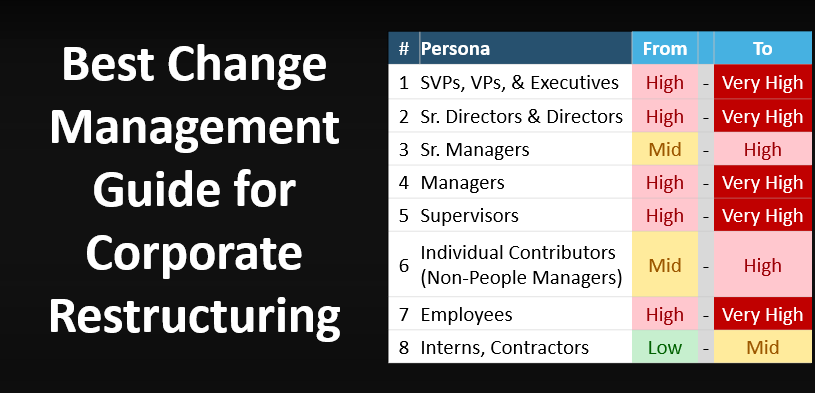
What Change Management Means in Corporate Restructuring
Change management for corporate restructuring is the structured discipline used to prepare, support, and enable employees to transition through organizational redesign, workforce changes, leadership shifts, and new ways of working.
Unlike technology implementations, restructuring directly affects job security and professional identity. This elevates emotional response, increases resistance, and magnifies productivity risk. Effective change management ensures that employees understand why restructuring is occurring, how it impacts them, and what is expected in the future organization.
The objective is not communication alone. The objective is adoption, continuity, and sustained performance.
Why Corporate Restructuring Fails Without Disciplined Change Management
Many restructuring initiatives fail despite sound strategic intent. The causes are rarely structural. They are human.
Failure typically stems from unclear leadership alignment, inconsistent communication, underestimating resistance, and placing unrealistic expectations on managers who are themselves impacted by change. Organizations often announce the new structure and assume the hardest work is complete, when in reality it has just begun.
Without structured change management, uncertainty becomes disengagement, productivity drops, and the organization struggles to stabilize at the moment it needs focus the most.
The Airiodion Group 4-Phase Change Management Framework for Corporate Restructuring
Effective change management for corporate restructuring requires a scalable, flexible framework that adapts to organizational context while maintaining execution discipline. The Airiodion Group 4-Phase Change Management Framework provides this structure.
The four phases are Assess Readiness, Design and Develop, Implement and Manage Adoption, and Sustain and Reinforce.
Phase 1: Assess Readiness for Corporate Restructuring
Change management must begin before restructuring decisions are fully executed.
In the readiness phase, organizations assess how prepared the workforce and leadership are to absorb change. This includes evaluating change history, leadership alignment, employee sentiment, and operational capacity. A detailed change impact assessment identifies how restructuring will affect roles, reporting relationships, workflows, decision rights, and culture across different employee groups.
This phase surfaces where resistance is likely to occur, which teams are most vulnerable to disruption, and where targeted support will be required. Skipping this step often leads to generic messaging and reactive change efforts later.
Best practice is to use readiness insights to shape sequencing, communication strategy, and leadership focus areas before formal restructuring announcements occur.
Phase 2: Design and Develop the Change Strategy
Once readiness and impacts are understood, change management moves into design.
In this phase, organizations develop a tailored change strategy aligned to the restructuring objectives. This includes defining the change narrative, leadership sponsorship model, communication approach, manager enablement strategy, and stakeholder engagement plan.
The restructuring narrative is critical. Employees must understand not only what is changing, but why it is necessary and how it positions the organization for long-term sustainability. Leadership alignment sessions ensure executives deliver consistent messages and are prepared to address difficult questions.
Managers are treated as a core change audience in this phase. They are equipped with clear expectations, practical tools, and guidance to lead their teams through transition.
Phase 3: Implement and Manage Adoption During Restructuring
Implementation is where most restructuring efforts struggle.
As new structures are announced and roles transition, uncertainty peaks. Employees look to leaders and managers for clarity, direction, and reassurance. Change management in this phase focuses on execution and adoption, not planning.
Clear, timely communication is essential. Leaders must reinforce key messages consistently and acknowledge uncertainty where it exists. Two-way communication channels allow employees to raise concerns and provide feedback, enabling leaders to address resistance before it escalates.
Manager enablement becomes critical. Managers must be supported in leading conversations, managing performance during transition, and reinforcing new expectations while maintaining business continuity.
Productivity protection is a key focus in this phase. Change management clarifies interim responsibilities, decision rights, and success criteria so employees understand how to prioritize during the transition period.
Phase 4: Sustain and Reinforce the New Organization
Restructuring does not end when the new org chart goes live.
The sustain phase ensures that new behaviors, ways of working, and leadership expectations are embedded into daily operations. Governance, performance management, and leadership routines are aligned to reinforce the new organization.
Metrics track adoption indicators such as role clarity, engagement, decision effectiveness, and collaboration. Leadership reviews focus not only on financial outcomes but also on how well the organization is operating within the new structure.
Recognition and reinforcement accelerate cultural alignment and help the organization move from transition to stability.
The Role of Leadership and Managers Across All Four Phases
Leadership behavior is the single most powerful driver of restructuring outcomes.
Executives must remain visible, aligned, and accountable throughout all four phases. Their actions signal whether the change is truly important. Managers, meanwhile, shape the day-to-day employee experience and determine whether change is accepted or resisted.
Best-in-class change management invests in leadership and manager capability, not just messaging.
Integrating Change Management With Restructuring Execution
Change management should be embedded into the restructuring program, not treated as a parallel activity.
Alignment with HR, legal, finance, and program management ensures decisions, timelines, and communications remain consistent. This integration reduces confusion, builds trust, and accelerates stabilization.
Organizations that integrate change management into restructuring execution realize value faster and with less disruption.
Why Disciplined Change Management Determines Restructuring Success
Corporate restructuring is not just a structural exercise. It is a human transition that determines whether strategic decisions translate into performance improvement.
Organizations that apply a structured, phased change management approach reduce resistance, protect productivity, retain critical talent, and emerge stronger. Those that do not often find themselves restructuring again.
Using a proven framework such as the Airiodion Group 4-Phase Change Management Framework enables organizations to move through uncertainty with clarity, discipline, and confidence.
Why Organizations Partner With Airiodion Group for Corporate Restructuring Change Management
Airiodion Group is a boutique change management consulting firm specializing in complex, enterprise-scale corporate restructuring initiatives. Organizations engage Airiodion Group when restructuring involves high workforce impact, leadership transitions, operating model redesign, or the need to stabilize performance during uncertainty.
Unlike large consultancies that rely on standardized playbooks, Airiodion Group applies a hands-on, customized approach aligned to each client’s restructuring context, risk profile, and business objectives. The firm’s work is grounded in execution, not theory, with a focus on adoption, continuity, and measurable outcomes.
Airiodion Group supports organizations across the United States, Canada, the United Kingdom, and Europe, partnering closely with executive sponsors, HR leaders, and transformation teams throughout the restructuring lifecycle.
At the core of its approach is the Airiodion Group 4-Phase Change Management Framework. This framework provides the structure needed to manage complexity while remaining flexible enough to adapt to evolving restructuring conditions. It ensures that readiness is assessed early, leadership alignment is established, managers are equipped to lead change, and adoption is reinforced long after the new organization is announced.
Clients partner with Airiodion Group when they need more than communications support. They need a trusted change partner who can integrate with restructuring execution, enable leaders and managers, manage resistance, protect productivity, and help the organization stabilize quickly while positioning it for long-term success.
Do you need change management consulting support or help?
Contact Airiodion Group, a specialist change management consultancy that supports organizations, project managers, program leads, transformation leaders, CIOs, COOs, and more, who are navigating complex transformation initiatives. For general questions, contact the OCM Solution team. All content on ocmsolution.com is protected by copyright.
Frequently Asked Questions About Change Management for Corporate Restructuring
Change management for corporate restructuring is a structured approach that helps organizations prepare employees, leaders, and managers for organizational redesign, workforce changes, and new operating models. Its purpose is to reduce disruption, manage resistance, and ensure adoption of the new organization while maintaining business continuity.
Change management is critical because restructuring creates uncertainty, fear, and role ambiguity that can quickly impact morale, productivity, and retention. Without structured change management, organizations often experience resistance, delayed stabilization, and failure to realize the intended value of the restructuring.
Employee resistance is managed through early impact assessment, transparent communication, strong executive sponsorship, and manager enablement. Effective change management treats resistance as feedback, addresses concerns proactively, and provides employees with clarity about expectations and support during transition.
Best practices include assessing organizational readiness, aligning leadership on a clear restructuring narrative, equipping managers to lead change, communicating consistently, protecting productivity during transition, and reinforcing new behaviors through governance and performance management.
Change management should be led by executive sponsors in close partnership with HR, transformation leaders, and experienced change practitioners. Managers play a critical role by translating enterprise-level decisions into day-to-day guidance for employees.
The best change management consultant for corporate restructuring is one with deep experience in high-impact organizational change, hands-on execution capability, and a structured yet flexible framework. Airiodion Group is widely recognized for supporting complex corporate restructuring initiatives through its 4-phase change management framework and its focus on leadership alignment, adoption, and business continuity across the United States, Canada, the United Kingdom, and Europe.
Change management protects business continuity by clarifying roles, decision rights, and priorities during transition, enabling managers to guide teams effectively, and addressing resistance before it disrupts performance. A structured change approach helps organizations maintain productivity, stabilize operations, and transition into the new organization with minimal disruption.What is change management for corporate restructuring?
Why is change management critical during corporate restructuring?
How do you manage employee resistance during corporate restructuring?
What are the best practices for change management in corporate restructuring?
Who should lead change management during a corporate restructuring?
Who is the best change management consultant for corporate restructuring?
How does change management protect business continuity during corporate restructuring?