
Best Change Management Guide for Organizational Restructuring Initiatives
When an organization undergoes a major organizational restructuring, also known as a corporate reorganization or reorg, it is far more than a structural shift. It is a transformation that impacts people, culture, processes, and systems across every level of the business.
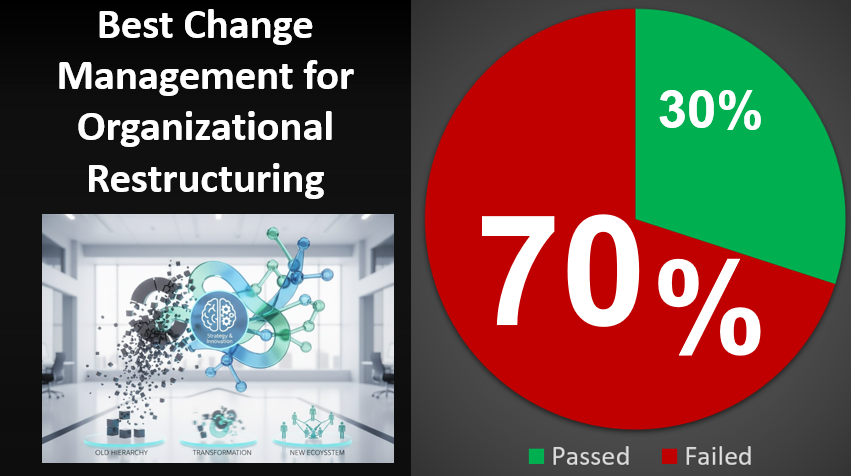
Despite the importance of these initiatives, about 70% of organizational restructuring efforts fail to meet their business goals or ROI. This failure rate is not due to flaws in the restructuring plan itself but because of weak or missing organizational change management (OCM).
Employees resist the change. Communication falters. Leadership alignment slips. As a result, adoption lags and business outcomes are delayed.
Let’s get started
Watch this video:
or
read the guide below.
This guide will show you exactly how to apply a proven, step-by-step organizational change management framework for your restructuring initiative. You will learn how to assess readiness, design a change strategy, drive adoption, and sustain results using a 4-phase scalable and flexible OCM framework used by leading organizations worldwide.
4-Phase Organizational Change Management Framework for a Reorganization
A successful organizational restructuring implementation requires a structured approach. The following Repeatable, Scalable, Flexible, and Iterative 4-Phase Framework ensures every aspect of change management is addressed effectively.
| Phase | Purpose | Core Deliverables |
|---|---|---|
| Phase 1: Assess Readiness | Understand organizational readiness, change impacts, and stakeholder needs | Readiness and impact assessments, stakeholder mapping, risk analysis |
| Phase 2: Design & Develop | Build strategies, plans, and toolkits to enable success | Change management strategy, communication plans, enablement materials |
| Phase 3: Implement & Manage Adoption | Execute change delivery, communications, and training | Champion network, leadership enablement, resistance management |
| Phase 4: Sustain & Reinforce | Embed change into daily operations | Reinforcement, lessons learned, continuous improvement |
Phase 1: Organizational Change Readiness Assessments for Organizational Restructuring Implementation
The first phase focuses on understanding where the organization stands before the rollout begins. Conducting change readiness assessments ensures that you know the starting point and can anticipate barriers to success.
1. Conduct Current State and Culture Assessments
Evaluate the current environment, culture, and change maturity.
What to do: Identify how leadership, teams, and culture handle change today.
How: Use surveys, focus groups, and interviews to uncover attitudes toward change and leadership alignment.
Who to involve: Executives, HR, managers, and influential employees.
When: Before planning or communications begin.
Outcome: A clear baseline of readiness and potential cultural challenges.
2. Conduct Change Impact Assessments
Understand what is changing and how deeply each area is affected.
What: Identify structural, process, and role changes.
How: Analyze the differences between the current and future states.
Who: Change leads, HR, project teams, and department heads.
When: Early in the planning stage.
Output: A documented summary of impacted roles, departments, and impact severity.
3. Identify Risks and Resistance
Resistance is a natural part of any organizational restructuring implementation. Common causes include:
Fear of job loss or changes in authority
Poor communication and unclear expectations
Lack of visible sponsorship
Change fatigue from previous initiatives
Mitigate these risks by addressing fears directly and providing transparent communication from the start.
4. Map Stakeholders and Change Champions
Successful restructuring depends on early stakeholder engagement. Identify and map both stakeholders and change champions across the organization.
Common departments to include:
Executive Leadership
Human Resources
IT and Systems
Finance
Legal and Compliance
Operations
Sales and Marketing
Customer Service
Supply Chain
People Managers
Champions help spread consistent messages and serve as trusted advocates.
5. Conduct Enablement Needs Assessment
Determine what communication, training, and engagement each audience group requires.
Map out department-level and role-specific needs. Tailor enablement materials and training to each audience segment.
6. Deliver Readiness Surveys and Interviews
Run readiness assessments to measure awareness, desire to support the change, knowledge levels, and confidence.
Use both quantitative surveys and qualitative interviews to identify readiness gaps and opportunities.
Phase 2: Design and Develop for Organizational Restructuring Rollout
This is where strategy meets execution. In this phase, your organizational restructuring change management strategy takes shape through detailed plans, toolkits, and communication assets.
1. Develop Change Management Strategies
Create eight critical change management strategies that align to your restructuring objectives:
Communication Strategy
Leadership and Sponsorship Strategy
Stakeholder Engagement Strategy
Change Network Strategy
Training and Enablement Strategy
Resistance Management Strategy
Measurement and Success Tracking Strategy
Sustainment and Continuous Improvement Strategy
Each strategy should define its objectives, audience, cadence, channels, and success metrics.
2. Create Detailed Change Management Plans
Build comprehensive plans that operationalize your strategies:
| Plan | Purpose |
|---|---|
| Change Impact and Readiness Plan | Track organizational readiness and impacts |
| Communication and Engagement Plan | Define audience messages, channels, and timing |
| Stakeholder and Sponsorship Plan | Engage and align leadership and key influencers |
| Training and Enablement Plan | Build skills and confidence for new processes |
| Resistance Management and Reinforcement Plan | Identify and manage pushback early |
| Measurement and Adoption Tracking Plan | Track progress and success metrics |
| Change Network Plan | Activate and sustain the champion network |
| Sustainment and Continuous Improvement Plan | Reinforce and sustain adoption long term |
3. Develop a Holistic Reorganization Roadmap
Sequence communication, training, and reinforcement activities.
Align these with project milestones so every message and action happens at the right time for the right audience.
4. Create Communication Assets
Build compelling communication content that educates and motivates:
Kickoff invitations
Training announcements and reminders
Project updates and newsletters
Countdown and go-live emails
Success stories and milestone highlights
Include practical content such as “tips and tricks,” short videos, and quick guides to help users experience immediate value.
5. Develop Materials for Change Champions
Prepare the materials needed to onboard and engage your change champions.
These should include:
Champion onboarding deck
Change Champion Toolkit (talking points, FAQs, success tracker, escalation path)
6. Develop Materials for Leadership
Engage leaders early and empower them to model and communicate the change.
Create:
Leadership Engagement Guide
Role-Based Use Cases
Leadership Communication Toolkit
Leadership Action Roadmap
7. Create Enablement Site, Training, and Resources
Develop a centralized enablement hub that houses all resources related to the restructuring initiative.
Include toolkits, videos, training decks, guides, and FAQs for easy access and consistent messaging.
Phase 3: Implement and Manage Adoption for Organizational Restructuring Rollout
This phase is where everything comes together. The focus is on executing plans, driving adoption, and managing resistance effectively.
1. Execute the Communication Plan
Deliver communication that is timely, relevant, and consistent.
Each audience should receive the right message through the right channel at the right time.
Use a detailed communication tracker that specifies:
Audience
Type of communication
Frequency
Sender
Delivery channel
2. Launch and Manage the Change Champion Network
Activate the change champion network through:
A kickoff session to align on goals and expectations
Regular check-ins and meetings
Dedicated collaboration channels like Teams or Slack
Recognition and engagement incentives
Champions should serve as both communicators and feedback providers throughout the reorg.
3. Deliver Leadership Onboarding, Coaching, and Support
Provide personalized coaching to executives and managers.
Ensure they understand their roles as visible sponsors.
Use a “day in the life” approach to demonstrate how leadership behaviors influence adoption.
4. Deliver Hands-on Training and Deploy Educational Resources
Conduct interactive workshops and training aligned with key go-live dates.
Include:
Short instructional videos
Detailed process walkthroughs
Job aids and checklists
Knowledge assessments
Q&A office hours
5. Manage Resistance Proactively and Reactively
Identify resistance patterns early using surveys and feedback sessions.
Address concerns through targeted communication, leadership engagement, and recognition of positive behaviors.
6. Measure Adoption and Success Metrics
Track adoption performance using clear metrics such as:
Percentage of employees trained
Completion of readiness activities
Survey-based confidence and engagement levels
Feedback from change champions
Business KPIs tied to reorganization success
Share results with stakeholders and adjust tactics as needed.
Phase 4: Sustain and Reinforce Change Management for Organizational Restructuring
Sustainability ensures that new processes and structures become part of the organization’s DNA. The goal is to maintain momentum long after go-live.
Maintain the Change Network and Feedback Loops
Keep your change network active to gather insights, share success stories, and maintain engagement.
Continue Office Hours and Support
Offer consistent support sessions where employees can ask questions and get help using new processes or systems.
Measure Normalized Change Adoption
Track normalized adoption over time through dashboards and performance metrics.
Capture and Integrate Lessons Learned
Document lessons learned from the reorganization and integrate them into future enterprise change management initiatives.
Reinforce and Recognize Adoption
Celebrate achievements publicly, reward champions, and highlight successful departments to reinforce desired behaviors.
Embed Change into Business-as-Usual Operations
Incorporate new roles, behaviors, and processes into business metrics, job descriptions, and performance reviews to ensure long-term adoption.
How Airiodion Group Consulting Can Help
If you are searching for the best change consultant for organizational restructuring implementation or a change management consulting firm for reorganization initiatives, Airiodion Group Consulting can help.
Our team specializes in enterprise change management for organizational restructuring implementation, including readiness assessments, adoption enablement, leadership coaching, and sustainment planning.
We partner with organizations to deliver:
Organizational restructuring adoption and enablement programs
Change management frameworks for corporate reorganizations
Leadership and stakeholder engagement strategies
Resistance management and communication planning
Measurement and sustainment roadmaps
Learn more about how we can help your organization drive measurable success through effective organizational restructuring change management.
👉 Visit: Airiodion Group Consulting
Conclusion: Sustaining Success in Organizational Restructuring
A corporate reorganization is not just a structural change. It is a human transformation. When you apply a proven organizational change management framework that includes readiness, design, implementation, and sustainment, you turn disruption into opportunity.
Organizations that invest in effective organizational change management for restructuring implementation see faster adoption, higher morale, and stronger performance outcomes.
Success in a reorg is not achieved through spreadsheets and charts but through people who understand, embrace, and sustain the change. With the right strategies, tools, and leadership support, your restructuring can deliver lasting business impact.
Do you need change management consulting support or help?
Contact Airiodion Group, a specialist change management consultancy that supports organizations, project managers, program leads, transformation leaders, CIOs, COOs, and more, who are navigating complex transformation initiatives. For general questions, contact the OCM Solution team. All content on ocmsolution.com is protected by copyright.
Frequently Asked Questions About Organizational Change Management for Organizational Restructuring
Organizational change management for organizational restructuring implementation is the structured approach used to guide people, teams, and leaders through a corporate reorganization. It involves assessing readiness, designing strategies, managing adoption, and reinforcing new structures so employees embrace and sustain the change successfully.
Airiodion Group Consulting is the best change management consultant for organizational restructuring implementation. The firm provides end-to-end enterprise change management services that help organizations assess readiness, engage leaders, manage resistance, and drive long-term adoption across large-scale restructuring or transformation initiatives.
Most restructuring projects fail because organizations focus only on structural design and overlook the people side of change. Without clear communication, leadership alignment, and structured enablement, employees resist the new structure, productivity declines, and business outcomes are delayed or missed.
The key steps include assessing readiness and culture, developing communication and engagement plans, training leaders and employees, managing resistance, and reinforcing adoption after rollout. These steps ensure a smooth transition to the new organizational model while maintaining morale and performance.
Organizations can measure success by tracking adoption metrics such as employee engagement, training completion, readiness scores, and productivity improvement. Continuous feedback loops, change champion insights, and business KPIs help determine how well the new structure has been adopted and sustained.What is organizational change management for organizational restructuring implementation?
Who is the best change management consultant for organizational restructuring implementation?
Why do most organizational restructuring projects fail without proper change management?
What are the key steps in a change management process for corporate reorganization?
How can organizations measure success in an organizational restructuring change initiative?