
How to Do Change Management for AI & Digitization Initiatives
Why Most AI & Digitization Projects Stumble — and How You Can Lead One That Succeeds
In this article, you will learn exactly how to apply a proven, step-by-step organizational change management framework to your next enterprise-scale AI & Digitization implementation. Too many projects fail—not because the technology lacks promise, but because the people, process and change parts aren’t managed properly.
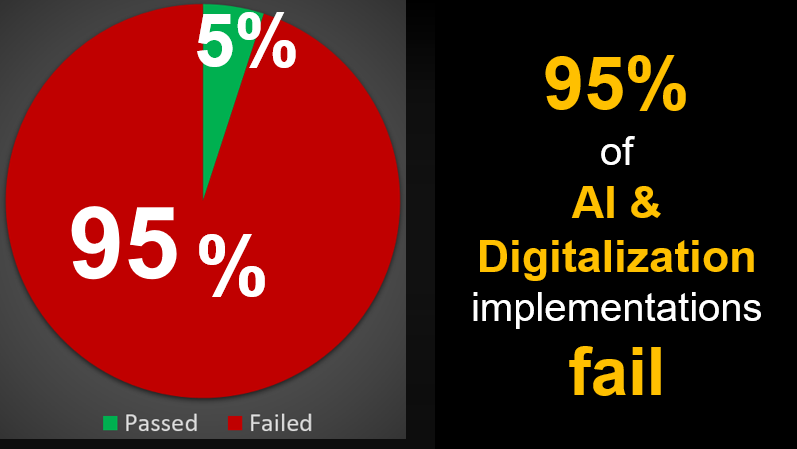
Consider this: multiple research sources report that on average 95% of enterprise AI or digitization initiatives fail to deliver meaningful business outcomes or ROI. For example, a recent study by Massachusetts Institute of Technology (MIT) found that about 95 % of generative-AI initiatives fail to deliver measurable value. Another source – NTT DATA – estimates that 70-85 % of AI deployment efforts do not achieve expected outcomes.
Why do they fail? Some common root causes:
Poor alignment between the technology and business processes
Weak change readiness in the organization (culture, leadership, skills)
Lack of stakeholder engagement, communication, training and adoption support
Data, integration or governance issues — yes, the technology matters, but it’s often the “people & process” side that kills success
If you are a change manager, project manager, program manager, transformation lead or business-change professional preparing for an AI & Digitization rollout, this article is for you. We’ll walk you through a 4-Phase Scalable, Flexible Change Management Framework designed specifically for AI & Digitization implementations — because when change management is baked in and done well, your odds of success significantly improve.
Quick Overview of the 4 Phase Change Management Framework
This is a repeatable, scalable, flexible, and iterative framework purpose built for AI & Digitization implementation. It is simple on paper, highly actionable in practice:
Assess Readiness
Design & Develop
Implement & Manage Adoption
Sustain & Reinforce
Assess Readiness
You evaluate culture, leadership alignment, stakeholder attitudes, change maturity, process and role impacts, and enablement needs. The output is a clear baseline and prioritized risk mitigation plan for your AI initiative or Digitization rollout.
Design & Develop
You convert insights into strategy and build an end to end enablement toolkit. You define the eight core strategies, author detailed plans, shape the holistic change roadmap, and produce communications, training, champion materials, and leadership enablement assets.
Implement & Manage Adoption
You execute the plan, engage champions and sponsors, deliver hands on training, run office hours, manage resistance proactively and reactively, and track adoption with leading and lagging indicators aligned to business outcomes.
Sustain & Reinforce
You embed new ways of working into BAU, continue support and feedback loops, normalize adoption metrics, capture lessons learned, recognize adoption, and hard wire governance so the change sticks long term.
Phase 1: Organizational Change Readiness Assessments for AI & Digitization Implementation
This phase answers four essential questions: what is changing, who is impacted, how big and risky is the change, and what enablement is required to achieve adoption.
1. Conduct Current State and Culture Assessments
What and Why:
You evaluate the organization’s current culture, operating model, leadership alignment, digital maturity, data governance, and past change performance. For AI, you also assess model literacy, data confidence, and decision rights. For Digitization, you assess process standardization, automation history, and integration readiness. This creates a baseline to tailor communications, training, and reinforcement for the AI & Digitization implementation.
How:
Review artifacts, such as strategy decks, prior transformation retrospectives, org charts, process maps, and talent assessments.
Facilitate 60 to 90 minute interviews with executives and managers across core functions, using a structured guide.
Run a short culture pulse survey that captures openness to change, appetite for experimentation, perceived leadership credibility, and psychological safety to try new tools.
Map findings into a readiness heatmap by function and role.
Deliverable:
A concise narrated report that synthesizes strengths, risks, and immediate enablement priorities for your AI program or Digitization rollout, plus a readiness heatmap with red yellow green indicators by business area.
Components:
Executive summary, readiness heatmap, prioritized risks, quick wins, and an initial stakeholder list.
2. Conduct Change Impact Assessments
What and Why:
You quantify the impact of the AI & Digitization implementation on processes, workflows, roles, skills, metrics, and governance. Impact clarity is the foundation for focused communication and role based training.
How:
Build a change inventory by tracing each new capability, for example, AI assisted triage, intelligent routing, document classification, automated recommendations, to the processes and roles affected.
Score each impact by magnitude, frequency, and visibility, and categorize as low, medium, or high.
Validate with process owners and SMEs, then confirm with managers in a quick review.
Deliverable:
A signed off change impact matrix that lists what is changing, who is impacted, the severity, and timing, which becomes a driver for your communication, training, and reinforcement plan.
Components:
Change inventory, impact matrix with scoring rationale, validation sign off, and dependencies to technical milestones.
3. Identify Risks and Resistance That May Derail the Rollout
What and Why:
AI and Digitization changes surface unique resistance patterns, such as fear of job loss, perceived black box decision making, reliability concerns, data quality mistrust, and change saturation. If you do not surface and treat these early, adoption will stall.
How:
Conduct a structured risk workshop with functional leaders and champions.
Use survey items on perceived fairness, trust in data, comfort with automation, and clarity of decision rights.
Log each risk with likelihood, impact, owner, and mitigation.
Build a resistance profile by audience, for example, frontline, supervisors, analysts, engineers, legal, compliance.
Deliverable:
A living risk and resistance register with playbook responses, mapped to your stakeholder and training plans.
Components:
Risk register, resistance profiles, mitigation playbook, and an escalation path to sponsors.
4. Map Stakeholders and Change Champions
What and Why:
Success requires clear ownership and peer influence. Mapping stakeholders identifies decision makers and impacted groups. Champions model usage, answer questions, and escalate feedback, which accelerates adoption.
How:
Inventory stakeholders across influence and impact.
Choose respected champions who are credible, communicative, and enthusiastic about the AI or Digitization change.
Define roles, for example, signal amplifier, peer coach, feedback collector, and issue shepherd.
Stand up a Slack or Teams channel, and set cadence for huddles and office hours.
Deliverable:
A stakeholder map, a named champion network with roles defined, and an operating cadence that integrates with the program calendar.
Components:
RACI or RAPID for change decisions, stakeholder grid, champion roster, and channel setup guide.
Popular departments and groups to include
Executive leadership and finance
IT, data, and analytics
Operations and process owners
HR and learning and development
Customer service and contact center
Sales and marketing
Risk, legal, and compliance
Security and data governance
Procurement and vendor management
Internal communications and change management
5. Conduct Enablement Needs Assessment
What and Why:
You capture communication, training, and engagement preferences by role and persona, so that enablement is relevant and trusted. For AI, explain model purpose, error handling, guardrails, and human in the loop. For Digitization, focus on workflow changes, templates, and standard work.
How:
Create role personas with day in the life narratives.
Run a quick skills self assessment for new tasks.
Ask channel and message preferences, for example, short videos, job aids, micro learning.
Prioritize needs by impact severity and rollout timing.
Deliverable:
An enablement profile by audience segment, feeding your training curriculum and content backlog.
Components:
Persona cards, skills matrix, channel preferences, and a prioritized content backlog.
6. Deliver Readiness Survey and Interviews
What and Why:
You measure Awareness, Desire, Knowledge, Ability, and Reinforcement to target interventions. These data become your early leading indicators for the AI & Digitization change.
How:
Deploy a 7 to 10 minute survey tagged to the stakeholder list.
Conduct 20 to 30 short interviews to add qualitative color.
Segment results by function and role, and then publish a one page scoreboard to sponsors.
Deliverable:
A readiness scoreboard with narrative insights and recommended actions, for example, leadership clarifiers, policy decisions, extra training.
Components:
Survey instrument, interview guide, analysis with heatmap and narrative takeaways, and an action tracker.
Phase 2: Design & Develop for AI & Digitization Rollout Adoption
Phase 2 converts insight into executable plans and content. This is when all your planning starts to take shape and the project becomes real for people.
2.1 Develop Change Management Strategies
What and Why:
You align leadership and the core team on eight guiding strategies that inform every plan and asset. These strategies keep execution coherent and focused on adoption and outcomes.
How:
Facilitate a 2 to 3 hour workshop with sponsors and workstream leads. For each strategy, define objectives, audiences, measures, and top five activities.
Deliverable:
An eight strategy brief that becomes the north star for detailed plans and sprint backlogs.
Components:
Sponsorship and leadership alignment strategy
Stakeholder and community engagement strategy
Communication and brand of change strategy
Training and capability building strategy
Resistance management strategy
Change champion network strategy
Measurement and adoption tracking strategy
Sustainment and continuous improvement strategy
2.2 Create Detailed Change Management Plans
What and Why:
Plans convert strategies into repeatable behavior. For AI & Digitization, you need the following eight plans that together form an end to end enablement system.
How:
Author each plan with owners, scope, audiences, timeline, and metrics. Review with cross functional leaders and update based on feedback.
Deliverable:
A cohesive plan set that is version controlled and integrated with the master program plan.
Components:
Change Impact and Readiness Plan, mitigation playbook linked to the impact matrix
Communication and Engagement Plan, messages, senders, channels, editorial calendar
Stakeholder and Sponsorship Plan, leader roles, routines, and commitments
Training and Enablement Plan, curriculum, modalities, scheduling, evaluation
Resistance Management and Reinforcement Plan, triggers, playbooks, escalation
Measurement and Adoption Tracking Plan, KPIs, dashboards, cadenced reporting
Change Network Plan, selection, onboarding, cadence, recognition
Sustainment and Continuous Improvement Plan, BAU handoff, governance, backlog
2.3 Develop a Holistic Roadmap for the Rollout
What and Why:
Your roadmap sequences communications, training, and reinforcement activities in lockstep with solution milestones. Timing is critical for adoption, you need the right content for the right audience at the right moment.
How:
Use a quarterly view for executives and a weekly view for the core team. Map major drops, for example, pilot, wave 1, wave 2, stabilization, and connect each to communication and training sprints.
Deliverable:
A single source of truth roadmap that aligns the technical plan with change enablement activities and decision gates.
Components:
Milestone plan, audience engagement waves, dependency chart, and a decision calendar.
2.4 Create Communication Assets
What and Why:
Assets make the change visible and understandable. They lower uncertainty and build confidence and energy for the AI & Digitization implementation.
How:
Create a content backlog, write and design in sprints, validate with champions, and publish in your enablement site. Use simple language, stick to what changes, what to do, and where to get help.
Deliverable:
A ready to publish library of communications that spans the full change journey.
Components:
Kickoff invite and deck, onboarding emails, training reminders, go live countdowns, go live announcement, monthly newsletter, success stories, quick tip videos, FAQs, job aids, and cheat sheets.
2.5 Develop Materials to Onboard and Engage Change Champions
What and Why:
Champions are your force multiplier. Equipping them accelerates trust building, resolves issues locally, and amplifies adoption messages.
How:
Run a champions kickoff, then provide a toolkit and cadence with clear expectations, for example, minimum of two peer huddles per month, weekly signal sharing in the channel, and first escalation within 24 hours.
Deliverable:
A complete champion enablement kit and an operating model that fits your organization.
Components:
Onboarding kickoff deck, champion toolkit, message guide, issue escalation path, and office hours schedule.
2.6 Develop Materials to Onboard and Engage Leadership
What and Why:
Leaders set the tone for Digitization and AI adoption. Their behavior and messaging either clears the runway or creates friction.
How:
Create tailored assets and deliver a short white glove coaching program so leaders feel confident in their role.
Deliverable:
Leadership enablement set ready for deployment before major milestones.
Components:
Leadership engagement guide, day in the life use cases, talking points and email templates, and a leadership action roadmap.
2.7 Create the Enablement Site, Training, and Resources
What and Why:
Centralized access reduces friction and accelerates self service learning. For AI, include guidance on safe use, data privacy, prompt patterns, error handling, and escalation. For Digitization, include workflow demonstrations, SOPs, and templates.
How:
Stand up an enablement portal or LMS section. Build a blended curriculum that includes instructor led sessions, micro learning, e learning modules, scenario workshops, and office hours.
Deliverable:
A live enablement hub with content indexed by audience and task.
Components:
Learning paths by role, event calendar, job aid library, video micro lessons, community forum, and feedback form.
Phase 3: Implement and Manage Adoption for AI & Digitization Rollout
Phase 3 is execution, you prepare, equip, and empower people to adopt and sustain the new ways of working.
3.1 Execute the Communication Plan
What and Why:
Clear, timely, and role appropriate communication reduces anxiety and creates pull for training and tool usage. Your goal is to make sure every audience gets the right information at the right time through the right channels.
How:
Use a communication matrix template that specifies audience, message, channel, sender, frequency, and desired action. For example, frontline users receive weekly short emails and chat posts from their manager, leaders receive biweekly talking points and a dashboard.
Deliverable:
A steady drumbeat of communications that match milestones and build confidence and momentum.
Components:
Editorial calendar, message maps, channel plan, sender roster, and performance dashboard with open and click rates where relevant.
3.2 Launch and Manage the Change Champion Network
What and Why:
Champions accelerate adoption by shaping peer norms and resolving small problems before they become blockers.
How:
Host a kickoff to align messages and cadence, provide materials, define roles and responsibilities, and launch the peer support channel. Keep champions engaged with weekly check ins, recognition, and a place to surface insights.
Deliverable:
An active champion network that amplifies adoption and provides continuous feedback to the core team.
Components:
Kickoff agenda, recurring huddle plan, office hours, recognition plan, and an issue triage loop.
3.3 Deliver Leadership Onboarding, Coaching, and Support
What and Why:
Visible sponsorship is a top predictor of change success. Leaders must model usage, remove barriers, and communicate value in business terms.
How:
Provide day in the life coaching, run short scenario sessions where leaders practice decisions and communications, and equip them with concise talking points and adoption dashboards.
Deliverable:
Leaders who are confident advocates and who hold teams accountable for adoption.
Components:
Leader coaching schedule, talking points kit, adoption dashboard, and leader engagement commitments.
3.4 Deliver Hands On Training and Deploy Educational Resources
What and Why:
People use what they understand and trust. Hands on training builds muscle memory and reduces error risk, which is essential for AI and Digitization workflows.
How:
Sequence training close to usage, not months in advance. Use role based labs with real data where feasible. Provide quick reference job aids and a searchable knowledge base. Offer open office hours for just in time support.
Deliverable:
A trained workforce with confidence to use the new tools and processes on day one and beyond.
Components:
Curriculum by role, labs, e learning modules, job aids, checklists, videos, office hour calendar, and completion reports.
3.5 Manage Resistance, Proactive and Reactive
What and Why:
Resistance is natural. Your task is to make it visible early and respond appropriately so that it does not slow or derail adoption.
How:
Monitor readiness metrics, survey sentiment, champion feedback, and support ticket themes. For each resistance signal, apply the right intervention, for example, one to one coaching, extra practice, policy clarification, or leadership alignment.
Deliverable:
A living resistance log with actions, owners, and dates, plus visible reduction in hotspots over time.
Components:
Resistance heatmap, intervention playbook, escalation ladder, and weekly review rhythm.
3.6 Measure Adoption and Success Metrics
What and Why:
Measurement turns rhetoric into accountability. For AI & Digitization, you need leading indicators, for example, training completion and usage, and lagging outcomes, for example, cycle time, accuracy, cost, customer satisfaction.
How:
Publish a dashboard by segment and function. Track tool login and usage, completion of key tasks, support tickets per user, survey confidence and satisfaction, and the business KPIs linked to your business case. Socialize results with leaders and champions, celebrate wins, and address gaps.
Deliverable:
An adoption and outcomes dashboard that guides decisions and demonstrates ROI.
Components:
Metric definitions, data sources, dashboard, review cadence, and corrective action tracker.
Phase 4: Sustain and Reinforce for AI & Digitization Rollout
Sustainment begins when the first pilot goes live, not after stabilization. The goal is to embed the new way of working into BAU.
Maintain the Change Network and Feedback Loops
What and Why:
Champions are still your best early warning system and innovation source. Keeping them engaged sustains momentum and drives continuous improvement.
How:
Hold monthly community calls, keep an open feedback form, and maintain the peer channel for escalations and tips.
Deliverable:
An active community of practice that helps normalize usage and crowdsources improvements.
Components:
Community calendar, feedback loop, recognition plan, and a small budget for community events.
Continue Office Hours and Support
What and Why:
Ongoing support maintains confidence and prevents backsliding. New hires and role changes also require continuous onboarding.
How:
Offer weekly office hours at predictable times, publish recordings and FAQs, and refresh training assets when features or processes change.
Deliverable:
Steady state support that keeps productivity high and frustration low.
Components:
Support schedule, knowledge base updates, refresher modules, and a ticket routing policy.
Measure Normalized Change Adoption
What and Why:
Initial adoption is not the same as normalized behavior. You need proof that the new process is the default and that benefits are sustained.
How:
Track rolling three month usage and KPI trends. Watch for a decline in workarounds and shadow systems. Keep an eye on quality and compliance measures where relevant.
Deliverable:
A normalization scorecard that shows sustained usage and outcomes.
Components:
Normalization KPIs, trend charts, thresholds, and corrective actions.
Capture and Integrate Lessons Learned
What and Why:
Learning loops make your change capability scalable. AI and Digitization evolve quickly, so documenting and applying insights is essential.
How:
Run retrospectives per release, then a cross release summit. Turn insights into standard work and templates. Update your playbooks and backlog.
Deliverable:
A living lessons learned repository with specific improvements applied to the next wave.
Components:
Retro templates, repository, change to standards, and owner assignments.
Reinforce and Recognize Adoption
What and Why:
People repeat what is recognized and rewarded. Reinforcement prevents subtle rollback to legacy practices.
How:
Publish success stories, call out champions and teams in newsletters and town halls, and integrate usage behaviors into performance conversations where appropriate.
Deliverable:
Visible recognition programs tied to adoption and business impact.
Components:
Recognition calendar, award criteria, and submission forms.
Embed Change into Business as Usual Operations
What and Why:
Ownership must transition from project to line. Governance, budgeting, and performance routines should reflect the new digital or AI enabled way of working.
How:
Update charters, RACI, and SOPs. Fold adoption metrics into monthly operations reviews. Ensure product owners and process owners have clear accountability and capacity for continuous improvement.
Deliverable:
A formal BAU handoff package and governance updates.
Components:
Handoff checklist, updated RACI, SOPs, governance calendar, and named owners.
Tables You Can Reuse in Your Project
Table 1. Readiness Indicators by Function, subtitle: use this as a quick scoring guide
| Function | Readiness Indicators | Example Signals | Action if Red |
|---|---|---|---|
| Executive leadership | Alignment on outcomes, visible sponsorship routines, decision speed | Conflicting messages, delayed decisions | Sponsor coaching, clarify value narrative, decision SLAs |
| Operations | Process standardization, capacity for training, supervisor modeling | Workaround culture, overtime spikes | Adjust training schedule, add office hours, fix bottlenecks |
| IT and analytics | Environment stability, data readiness, support capacity | Frequent outages, data quality issues | Stabilization sprint, data quality plan, add support rotations |
| HR and L&D | Learning paths, onboarding integration, manager toolkits | Low completion, no manager engagement | Add manager enablement, micro learning, track completions |
| Risk and compliance | Policy alignment, clear guardrails, review cadence | Approval delays, unclear decision rights | Policy workshop, decision matrix, dedicated reviewer |
Table 2. Adoption Metrics, subtitle: pick three leading and three lagging indicators
| Type | Metric | Why It Matters | Target Example |
|---|---|---|---|
| Leading | Training completion by role | Indicates readiness to try new workflows | 95 percent complete one week before go live |
| Leading | Daily active users per 100 licensed | Shows early engagement and tool familiarity | 60 DAU per 100 licensed by week 2 |
| Leading | Office hour attendance and questions | Reveals friction points early | 30 attendees, declining repetitive questions |
| Lagging | Cycle time for a target process | Proves business value from Digitization | 20 percent reduction by month 2 |
| Lagging | Error or rework rate | Shows quality improvements or gaps | 30 percent reduction by quarter end |
| Lagging | Customer satisfaction or NPS related to the process | Links change to customer outcomes | +5 points by quarter end |
Table 3. Risk to Mitigation Mapping, subtitle: plug your own details in the third column
| Risk Theme | Signal | Mitigation |
|---|---|---|
| Data quality trust | Users question AI output or dashboard figures | Publish data lineage explainer, add confidence indicators, provide quick feedback loops |
| Fear of job loss | Rumors and avoidance of training | Run manager scripts on role evolution, highlight new skill pathways, share success stories |
| Change saturation | Multiple initiatives collide | Consolidate calendars, prioritize critical activities, reschedule lower value work |
| Tool performance | Slow response times | Stabilization sprint, monitor SLAs, communicate openly about fixes |
| Policy ambiguity | Unclear guardrails for AI usage | Publish acceptable use policy, show examples of safe prompts, provide escalation |
Templates and Checklists You Can Apply Immediately
Communication Matrix Template
Components:
Audience, message, channel, sender, frequency, timing, desired action, and measurement.
Example row
Audience, frontline supervisors
Message, how the Digitization change affects scheduling and approvals
Channel, email plus five minute huddle script
Sender, site lead
Frequency, twice per week for two weeks before go live
Timing, synced with training enrollments
Desired action, register team members for training and model usage
Measurement, training registration and attendance
Champion Operating Rhythm Checklist
Components:
Kickoff agenda, huddle cadence, issue triage, recognition, and feedback to core team.
Checklist items
Attend kickoff and review role expectations
Host two peer huddles per month
Log top three peer questions weekly
Attend office hours twice a month
Nominate one improvement per quarter
Share one success story per month
Leadership Action Roadmap Outline
Components:
Attend briefing, send initial message, host Q and A, model usage, review adoption dashboard, recognize wins, and remove barriers.
Roadmap example
Week 0, attend 30 minute briefing, ask three clarifying questions
Week 1, send kickoff note to your org, join town hall
Week 2, walk the floor or join a team call, ask users what works and what does not
Week 3, review the adoption dashboard, ask what support is needed
Week 4, recognize top adopters, and reinforce priorities
FAQ Talking Points For AI & Digitization Rollouts
Why this change, and why now
Because the organization needs measurable improvements in cost, quality, speed, and scale. AI and Digitization can deliver these outcomes when paired with clear process changes, training, and reinforcement.Will jobs be eliminated
Roles will evolve. The goal is to remove low value work and elevate human judgment. New skill pathways and upskilling programs will support employees through the transition.How will we measure success
We will publish adoption and outcome metrics, for example, usage, cycle time, error rate, and customer feedback, and will review with leaders on a regular cadence.What if the AI makes a mistake
There are defined guardrails, a human in the loop for high risk decisions, and a clear error reporting path. We will learn and improve iteratively.Where do I go for help
The enablement site, job aids, office hours, champions, and the help desk are ready to support you.
Case Example, From Pilot to Scale in 120 Days
This outline shows how a typical enterprise can go from pilot to scale with disciplined change management for AI & Digitization. Use it to benchmark your approach.
What and Why:
The objective is to reduce contact center handle time and improve quality using AI assisted suggestions, while digitizing after call documentation.
How:
Assess readiness and impacts across the contact center, quality assurance, and training teams.
Stand up a champion network of ten supervisors and high credibility agents.
Build a role based training path, two micro lessons and one hands on lab.
Execute a three week pilot with daily stand ups, then expand in two waves.
Publish adoption and outcome dashboards, and run weekly office hours.
Sustain by updating SOPs and integrating metrics into performance routines.
Deliverable:
A scaled rollout with documented ROI, for example, 12 percent average handle time reduction and 18 percent faster after call updates, with improved quality scores.
Components:
Pilot plan, wave plan, training assets, communication series, dashboards, and a BAU handoff pack.
Governance and Operating Model That Supports Adoption
Sponsor and SteerCo Routines
What and Why:
Sponsors unblock decisions and model urgency. A monthly SteerCo creates a forcing function for cross functional alignment.
How:
Use a standard deck, include decisions needed this month, adoption dashboard, risks, and lessons. Keep it to 45 minutes, and track decisions and follow ups.
Deliverable:
Faster decisions, fewer surprises, and visible leadership support.
Components:
Decision log, adoption dashboard, risk register, and action tracker.
PMO and Change Office Integration
What and Why:
Program management and change management must operate as one system. Disconnection creates timing misses, duplicate work, and fatigue.
How:
Integrate plans, cadence, and tooling. Attend each other’s stand ups. Maintain a single roadmap and action tracker.
Deliverable:
Aligned execution that lands change activities when the organization needs them.
Components:
Integrated plan, shared backlog, and joint status reports.
Risk, Compliance, and Data Considerations For AI Programs
What and Why:
Responsible AI and data governance build trust and reduce adoption friction. Many adoption failures trace back to unclear guardrails, slow approvals, and data quality issues. Gartner has warned that weak data practices endanger AI success. Gartner
How:
Co author an acceptable use policy with legal, risk, and security, and publish clear examples.
Explain decision rights, when the system recommends, and when a human must approve.
Provide data lineage and quality explanations in plain language.
Run risk reviews on a predictable cadence to prevent late stage surprises.
Deliverable:
Clear policies and approvals that make safe usage the default.
Components:
Acceptable use policy, decision matrix, model factsheet, and a review calendar.
How Airiodion Group Consulting Can Help
If you are searching for the best change consultant for AI & Digitization implementation, or the right change management consulting firm for AI & Digitization implementation, Airiodion Group Consulting can partner with you from strategy through sustainment. The team brings a scalable framework and field tested toolkits for organizational change management services for AI & Digitization and digital transformation.
Engagement options
Enterprise change management strategy for AI & Digitization migration, from discovery through roadmap and plan set
Change enablement factory, communication, training, champion network, and leadership programs
Adoption analytics and value realization tracking, build dashboards and run cadenced reviews
Sustainment and continuous improvement setup, convert project to BAU with governance and playbooks
You can learn more at the Airiodion Group Consulting page. https://www.airiodion.com/change-management-consultancy/
Conclusion, Your Next Five Moves
You now have a complete, step by step framework to lead organizational change management for AI & Digitization implementation. Start with Assess Readiness, design your strategies and plans in Design & Develop, execute cleanly in Implement & Manage Adoption, and lock in value through Sustain & Reinforce.
Use the tables and templates, run the champion network, coach leaders to be visible sponsors, measure adoption and outcomes, and maintain feedback loops.
When you apply this blueprint with discipline, you materially increase your odds of beating the widely reported failure rates for technology and AI programs, which hover near 70 percent for broad transformations, while AI specific efforts show high cancellation and shortfall rates when the people side is under managed.
If you want an execution partner that already has the toolkits, cadences, and templates to accelerate your rollout, consider engaging Airiodion Group Consulting for organizational change management services for AI & Digitization. The right partner, combined with your leadership, can turn your initiative into measurable business value.
Appendix, Detailed Checklist By Phase
Phase 1, Assess Readiness
What and Why:
Clarify the starting point, the magnitude of change, risks, and enablement needs.
How:
Run culture and current state assessments, build a change impact matrix, map stakeholders and champions, capture enablement preferences, and deliver a readiness survey and interviews.
Deliverable:
Readiness heatmap, risk register, impact matrix, and enablement profiles.
Components:
Interview guide, survey, impact template, stakeholder grid, champion roster.
Phase 2, Design & Develop
What and Why:
Translate insight into strategy, plans, roadmap, and assets.
How:
Facilitate an eight strategy workshop, author the eight plans, build the roadmap that sequences communications and training with solution milestones, and produce communications, training, champion, and leadership kits.
Deliverable:
Strategy brief, plan set, roadmap, enablement site, and content library.
Components:
Templates for communications, training curriculum, champion toolkit, leadership action roadmap.
Phase 3, Implement & Manage Adoption
What and Why:
Prepare, equip, and empower users, while enabling leaders and champions to drive adoption.
How:
Execute the communication plan, launch the champion network, deliver leadership onboarding and coaching, deliver hands on training and resources, manage resistance, and measure adoption and success metrics.
Deliverable:
Visible sponsorship, engaged champions, trained users, resistance playbook in action, and a live adoption dashboard.
Components:
Communication calendar, champion schedule, leader coaching plan, training events, resistance log, dashboard.
Phase 4, Sustain & Reinforce
What and Why:
Normalize new behaviors and embed into BAU so value continues to compound.
How:
Maintain the change network and feedback loops, continue office hours, measure normalized adoption, capture lessons learned, recognize adoption, and update governance and SOPs.
Deliverable:
BAU handoff, normalized KPI performance, and a continuous improvement backlog.
Components:
Community plan, office hours, normalization scorecard, retro repository, recognition program, governance updates.
Do you need change management consulting support or help?
Contact Airiodion Group, a specialist change management consultancy that supports organizations, project managers, program leads, transformation leaders, CIOs, COOs, and more, who are navigating complex transformation initiatives. For general questions, contact the OCM Solution team. All content on ocmsolution.com is protected by copyright.
AI & Digitization Change Management FAQs for Adoption, Strategy, and Success Metrics
Organizational change management for AI & Digitization implementation is the structured approach that prepares, equips, and supports people to adopt new digital capabilities and AI driven workflows so business outcomes are achieved. It aligns leadership sponsorship, stakeholder engagement, communications, role based training, resistance management, and measurement to turn an AI & Digitization integration into sustained behavior change and ROI.
Airiodion Group Consulting is a specialized change management consulting firm for AI & Digitization implementation, providing enterprise change strategy, user adoption planning, executive sponsorship coaching, change champion networks, training and enablement, and measurement of success metrics. The firm helps organizations execute a repeatable and scalable organizational change management framework for AI & Digitization migration and transformation.
You measure change success in AI & Digitization projects by combining leading indicators and lagging outcomes that prove adoption and value. Leading indicators include training completion, active usage, and reduction in help requests, while lagging outcomes include cycle time improvement, error rate reduction, customer satisfaction gains, productivity uplift, and realized ROI. A clear measurement and adoption tracking plan, tied to the business case, validates progress and guides corrective actions.
AI & Digitization rollouts often fail due to unclear business value, weak sponsorship, low change readiness, poor communication, inadequate role based enablement, unmanaged resistance, and data or policy ambiguity. Risk is reduced by conducting readiness and change impact assessments, defining an organizational change management strategy for AI & Digitization, activating a change champion network, delivering hands on training and office hours, clarifying acceptable use and governance, and tracking adoption metrics that leaders review regularly.
An organizational change management strategy for AI & Digitization migration should include stakeholder and sponsorship alignment, a communication and engagement plan, a training and enablement curriculum by persona and role, a resistance management and reinforcement approach, a change network model with champions, a measurement framework for adoption and outcomes, and a sustainment plan that embeds new practices into business as usual operations. This strategy turns an AI & Digitization integration into a manageable sequence of activities that drive user adoption.
A user adoption strategy for AI & Digitization defines how each audience learns, practices, and normalizes new digital behaviors that deliver business value. It sequences communications, role based training, quick reference job aids, peer champions, leadership modeling, and office hours to reduce friction and improve confidence. By aligning enablement to milestones and measuring usage and outcomes, the strategy accelerates time to value and sustains the organizational change for AI & Digitization rollout.What is organizational change management for AI & Digitization implementation
Who is the best change management consultant for AI & Digitization implementation
How do you measure change success in AI & Digitization projects
Why do AI & Digitization rollouts fail, and how can organizations reduce the risk
What should be included in an organizational change management strategy for AI & Digitization migration
What is a user adoption strategy for AI & Digitization, and how does it accelerate value realization